

Alejandra Meneses
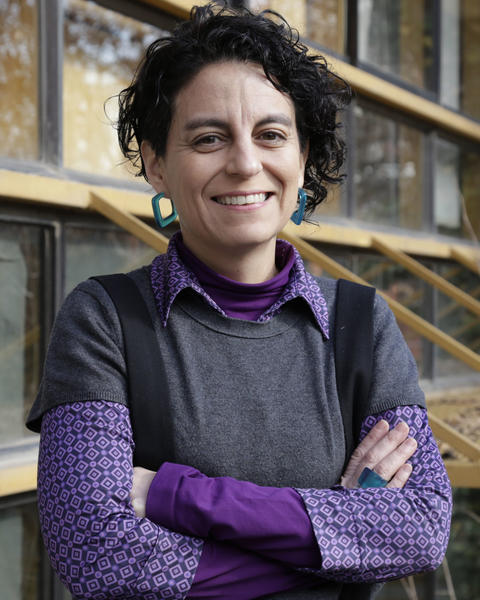
Alejandra Meneses is an Associate Professor at the Campus Villarrica of the Pontificia Universidad Católica de Chile and was also a professor at the Faculty of Education of the same university. Her research and teaching are at the convergence of the fields of linguistics, education, and science with a focus on language development and multimodality across school ages and their associations to literacy and science education. She has published on topics related to language for school literacy, text-based discussion, multimodal comprehension, and literacy in digital contexts in Spanish and English. She has collaboratively developed an intervention to promote learning in science through language and literacy to reverse educational inequalities (Project CLIC!).
Alejandra also led the improvement process of the initial teacher education programs of the Faculty of Education at PUC, taking a leadership role in designing and implementing a practice-based teacher education model. In her teaching for the preparation of teachers, Alejandra has implemented innovative strategies for orchestrating digital tools for learning. In particular, she has implemented flipped classrooms for literacy methods. She has also co-created with colleagues a MOOC on Coursera on Practice-based teacher education for developing 21st-century skills.
Alejandra is a member of Academia Chilena de la Lengua (Santiago) where she is a contributor to the discussion on inclusive language after the 2018 Chilean feminist protests. She has been interviewed on this topic in different media, such as El Mostrador, PAUTA and Revista Universitaria. Also, she has prepared a digital module about "How language changes" for Media UC.
Alejandra headed a collaborative work with more than 90 authors –academics and schoolteachers– entitled Pedagogies of proximity: Learning in times of crisis (Didácticas para la proximidad: Aprendiendo en tiempos de crisis) for the Mesa Social COVID-19 to develop adaptive guidelines for teaching in times of crisis. The report proposed learning pathways in Arts, Mathematics, Science, History, Language, English as a Second Language, and Physical Education for different connectivity situations.
Alejandra consistently collaborates on different educational policy forums in Chile and Latin America, as well as participated in teacher education workshops with various organizations and NGOs. She founded the interdisciplinary platform Factoría Ideas, a community that brings together teachers and researchers focused on promoting social change through educational equity. Her work is based on trust in teachers as agents of social change, and she works so that each person can be recognized according to their dignity and be able to raise their voice.